

Russia has officially moved from prohibition to regulation. The State Duma passed a bill legalizing Bitcoin, Ethereum, and XRP as property. This grants clear ownership rights while capping how much ordinary citizens can buy each year. It is a decisive shift for a nation that once kept the sector in the shadows due to capital flight fears.
For years, authorities warned of money laundering and uncontrolled capital leaving the country. The new law aims to bring that activity into the formal financial system instead of driving it underground. By defining major cryptocurrencies as property, the state now recognizes them as assets that can be owned, transferred, and taxed within its borders.
The bill creates a two-tiered market structure. Non-qualified investors face a strict annual purchase limit of 300,000 rubles to mitigate systemic risk. Qualified participants operate under different rules. Regulated exchanges will function legally, but the cap ensures retail participation remains constrained even as the asset class gains official status.
The immediate reaction is likely a mix of institutional interest and retail caution. International traders may see clarity in a previously hostile jurisdiction as a signal to engage with Russian platforms. Domestic buyers face hard limits on their exposure. Large players could thrive under the new framework while individual access remains tightly controlled by the 300,000-ruble ceiling.
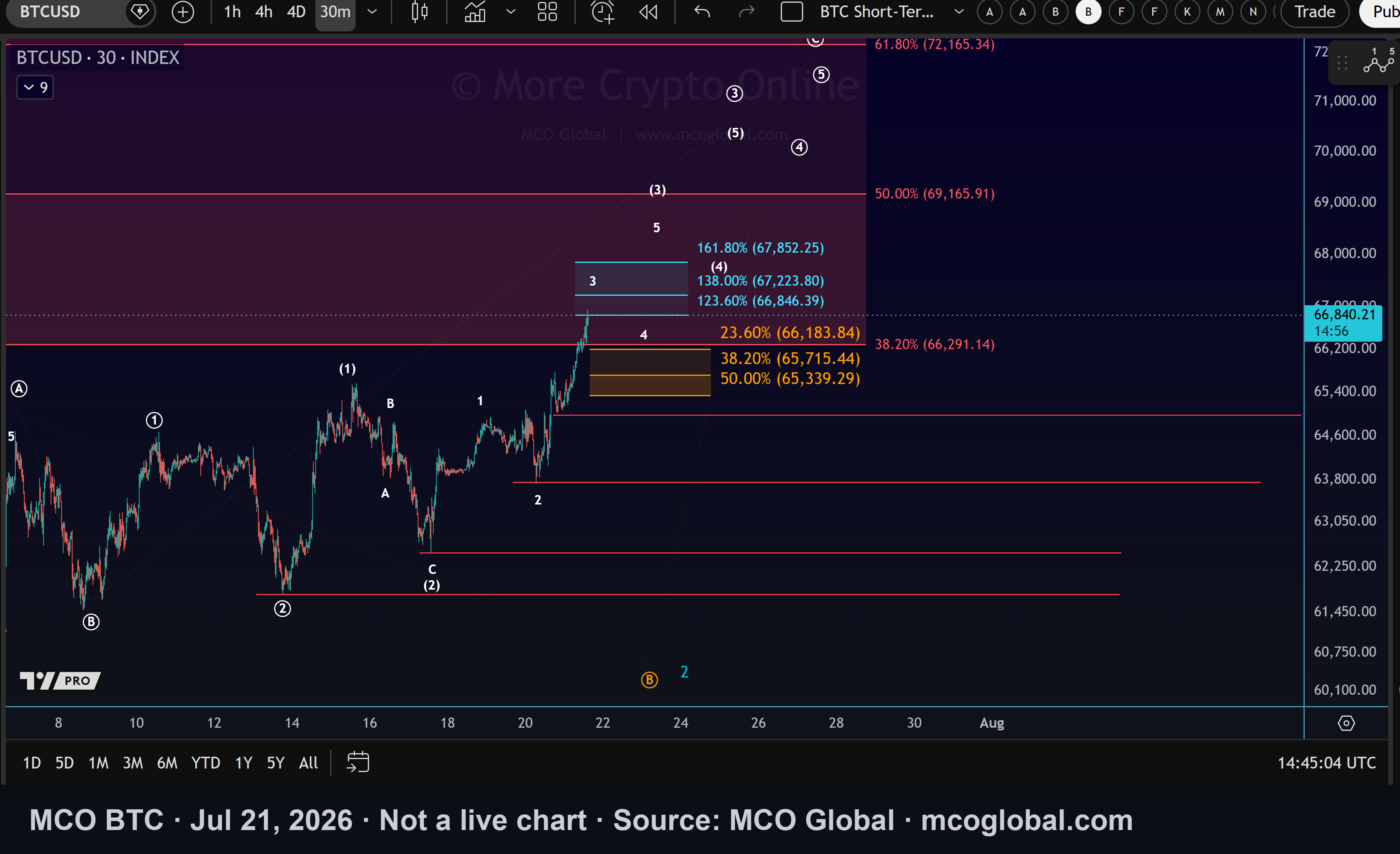
This regulatory shift arrives during a specific technical juncture for Bitcoin. As MCO noted on July 18, the current advance is viewed as a corrective countertrend rally within a larger bearish structure. The preferred view remains that this recovery may still extend toward the major resistance region between 69,000 dollars and 72,000 dollars. But if the move fails before reaching those targets, micro support sits at 65,000 dollars.
The law's success will depend on whether regulators can balance innovation with strict capital controls in a volatile economic environment. Whether the 300,000-ruble limit stifles domestic adoption or merely channels it into qualified accounts decides if Russia becomes a true hub for digital assets. Global liquidity flows toward this new framework only if exchanges adapt quickly to these rules. The next test is whether local banks will actually facilitate these transactions under the new rules.