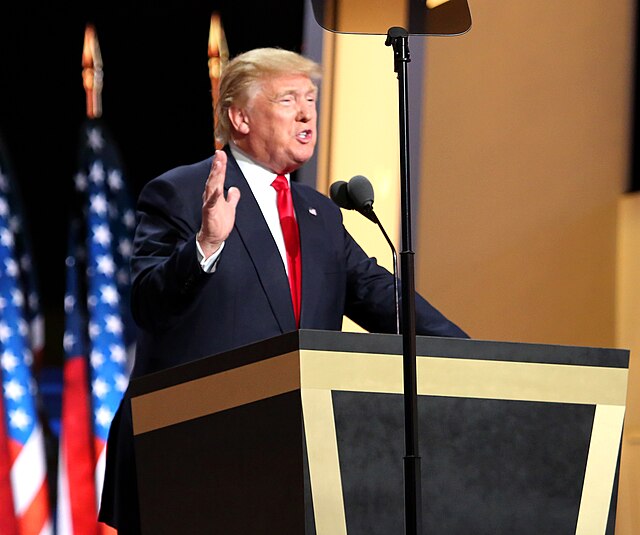
President Donald Trump landed in Beijing on Wednesday for a two-day summit with Chinese President Xi Jinping, bringing more than a dozen US corporate leaders including Apple's Tim Cook, Tesla's Elon Musk, Boeing's Kelly Ortberg, and Nvidia CEO Jensen Huang, who joined the trip last-minute on an Alaska stopover. The arrival ceremony at Beijing Capital International Airport featured 300 Chinese children waving US and Chinese flags as Trump descended from Air Force One. Formal meetings begin Thursday and run through Friday.
The summit was originally scheduled for March but postponed in the wake of the US-Israeli strikes on Iran on February 28. Effective tariffs on Chinese goods now sit near 24 percent, with select categories still as high as 47 percent. Beijing has extended its 178-category exclusion list to November 2026. Recent trade data shows China's exports rose 14.1 percent year-on-year in April to a record $359.4 billion, with imports up 25.3 percent to $274.6 billion. The offshore yuan held steady at roughly 6.79 to the dollar, its strongest level since February 2023.
The CEO delegation signals the deal mix Washington is targeting. A long-delayed Chinese commitment to purchase up to 500 Boeing 737 MAX jets sits at the top of the list, alongside fresh soybean and beef orders on top of the 25-million-metric-ton annual soybean pledge Beijing made in late 2025. A parallel "Board of Trade" and "Board of Investment" framework, sketched out in working-level talks, may also surface. Iran sits over everything else. Nomura's Chief China Economist Ting Lu set expectations directly: "In our view, the summit will be more about avoiding an unnecessary escalation of tensions and managing risks than building up structural mechanisms and forging deep friendships." The administration is also pushing Beijing to use its leverage with Tehran to reopen commercial flow through the Strait of Hormuz.
Wall Street traded mixed mid-session. The Dow Jones Industrial Average fell 0.4 percent, weighed down by industrials and value names still digesting Wednesday morning's 6 percent year-on-year PPI print. The S&P 500 rose 0.5 percent and the Nasdaq added 1.0 percent. Chip stocks led the green tape, with Nvidia getting a sentiment boost from Huang's late addition to the delegation.
Boeing is the most direct beneficiary if the aircraft order lands, followed by the agricultural complex on a soybean announcement. The semiconductor sector is the wild card. Any softening of the current US chip export-control regime, or even an implied gesture, would re-rate Nvidia, AMD, and Applied Materials immediately. Iran is the lever the market is not pricing. A deal that opens Hormuz commercial flow would compress the $14 to $18 per barrel geopolitical risk premium Goldman estimates is currently baked into Brent. Without that, the summit reads as a managed thaw, not a breakthrough.
This trip is structured to look like a breakthrough and deliver as a thaw. Both sides priced that into expectations weeks ago.
Trump Lands in Beijing for Xi Summit With Apple, Tesla, Boeing, Nvidia CEOs in Tow
Trump landed in Beijing on Wednesday for a two-day summit with Xi Jinping, bringing a dozen US CEOs including Apple's Tim Cook, Tesla's Elon Musk, Boeing's Kelly Ortberg, and Nvidia's Jensen Huang. Formal talks start Thursday.