

Sneakers on retail display: an illustrative photograph for the sportswear sector.
After long price declines, familiar sportswear brands can look like bargains. But a lower share price does not answer the decisive question: have buyers regained enough strength to sustain a new upward trend? The video analysis dated 21 October 2026 offers three very different answers for Nike, Adidas and Under Armour.
Nike provides an early indication, Adidas a more developed recovery, and Under Armour mainly a clear boundary for a fragile setup. All levels discussed here come from that analysis and are not live prices.
Nike: an early signal on a smaller timeframe
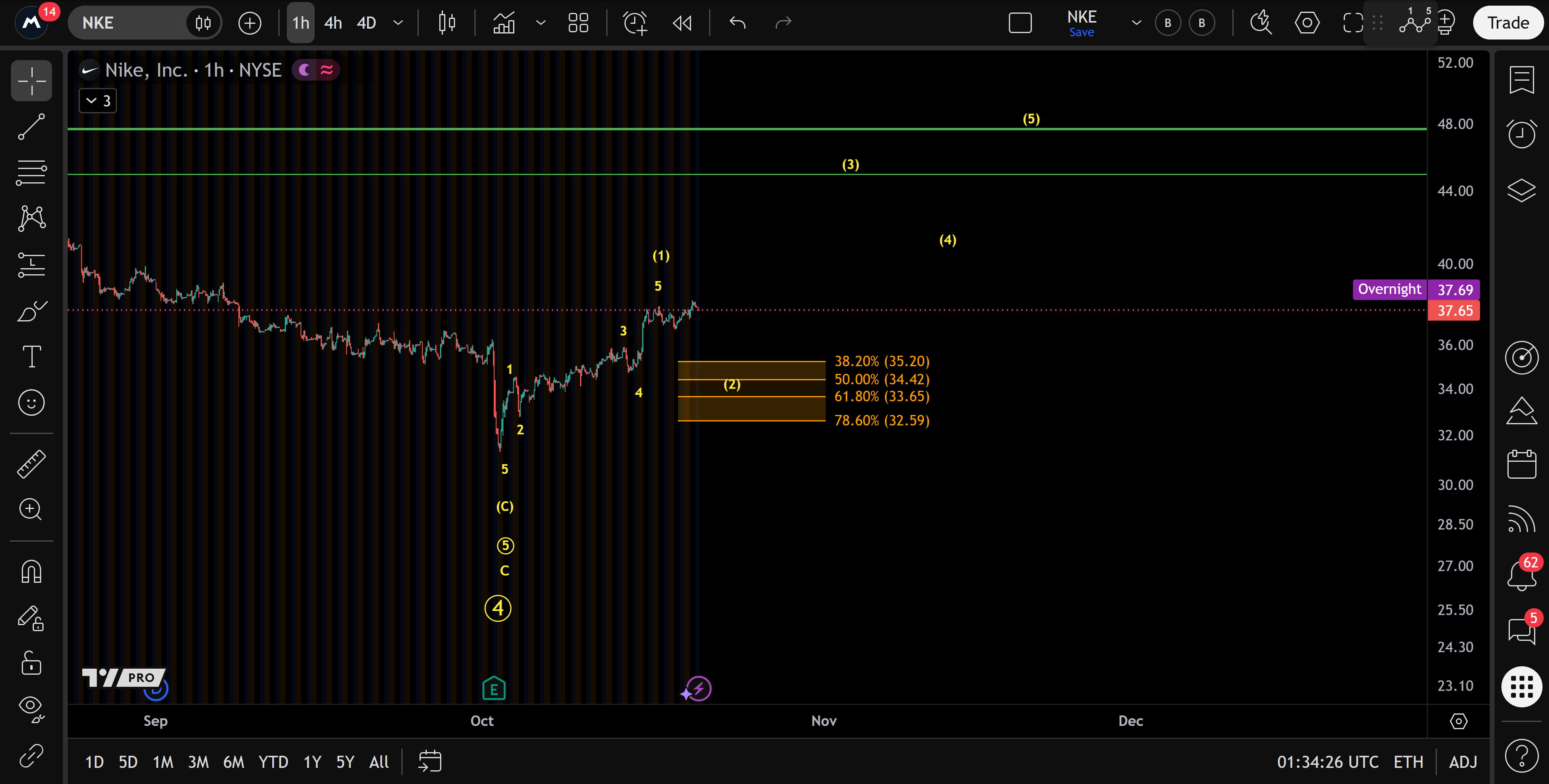
Nike has an encouraging starting point on a small timeframe. The hourly chart shows an initial five-wave advance that has taken out the previous local highs. It can be interpreted as a possible first upward wave. That small pattern alone does not establish the end of a decline lasting several years.
For a subsequent pullback, the video analysis identifies support at approximately $32.60–$35.20. The original chart places the lower boundary more precisely at $32.59. A constructive continuation would involve a higher low in this area, followed by another breakout to the upside. The first small advance could then develop into a larger impulsive structure.
That expansion is the missing confirmation. The zone is an area to monitor, not proof that buyers will necessarily take control there. Until the larger upward impulse develops, Nike remains an early candidate for a turn.
Adidas has already taken the next step
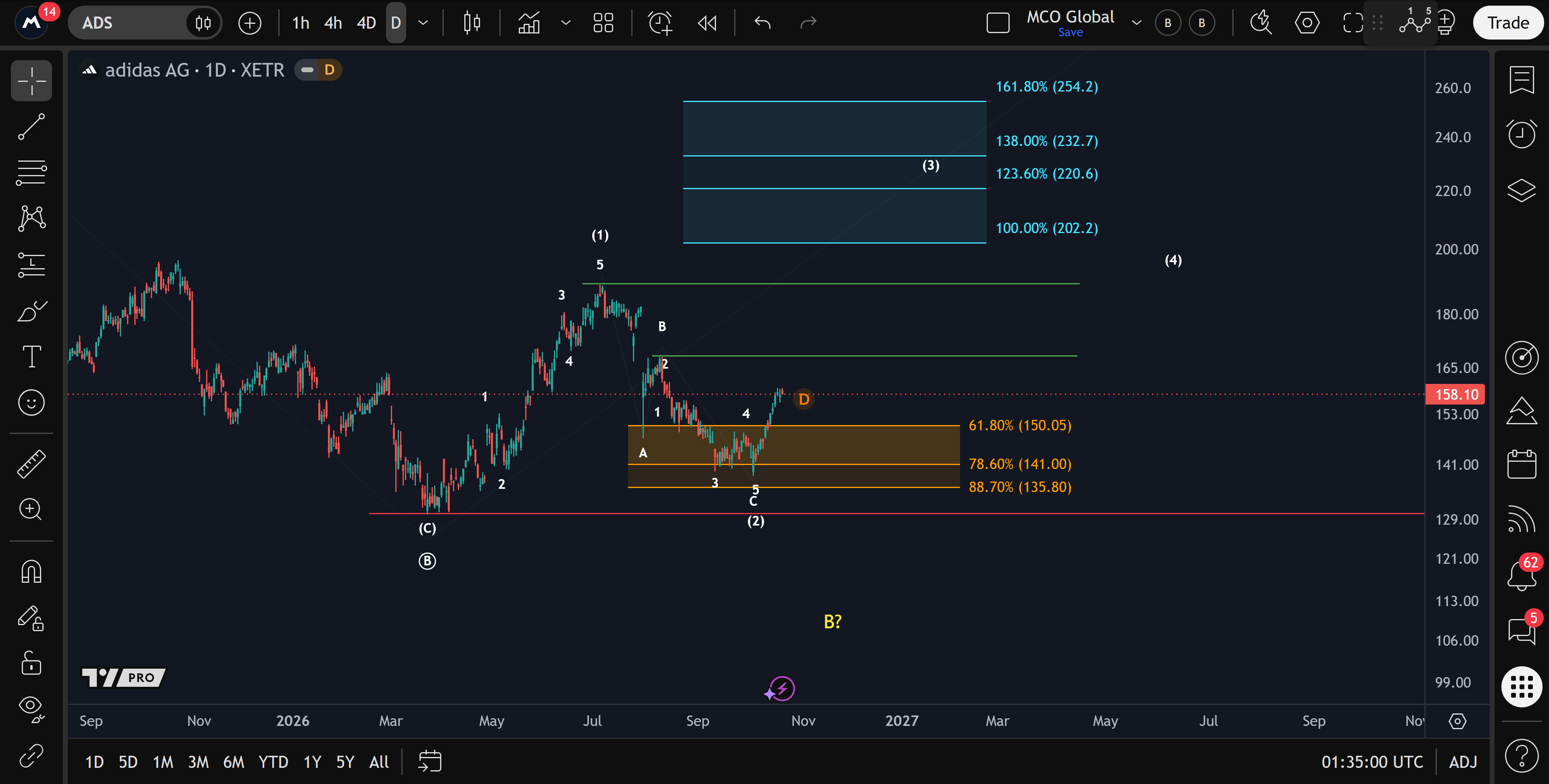
On the daily chart, Adidas is furthest along in this comparison. A five-wave advance from the spring low into the summer was followed by a pullback into support. The stock has since reacted higher again. That is the bullish sequence the video analysis had been following in earlier updates.
The sequence matters more than a single green candle: an advance, a correction and then an attempt to start the next upward leg. In the Elliott wave count, that next leg could develop into a third wave. This is an interpretation of the structure, rather than a guarantee of future prices.
The analysis places the next resistance levels at roughly €168 and €190. If price clears those obstacles and continues to build its upward structure, the discussed target region around €202–€233 becomes more relevant. A break below approximately €130 would undermine the currently preferred bullish scenario. The recovery would then need to be reassessed, with a merely corrective bounce remaining the obvious alternative.
Under Armour needs evidence of strength
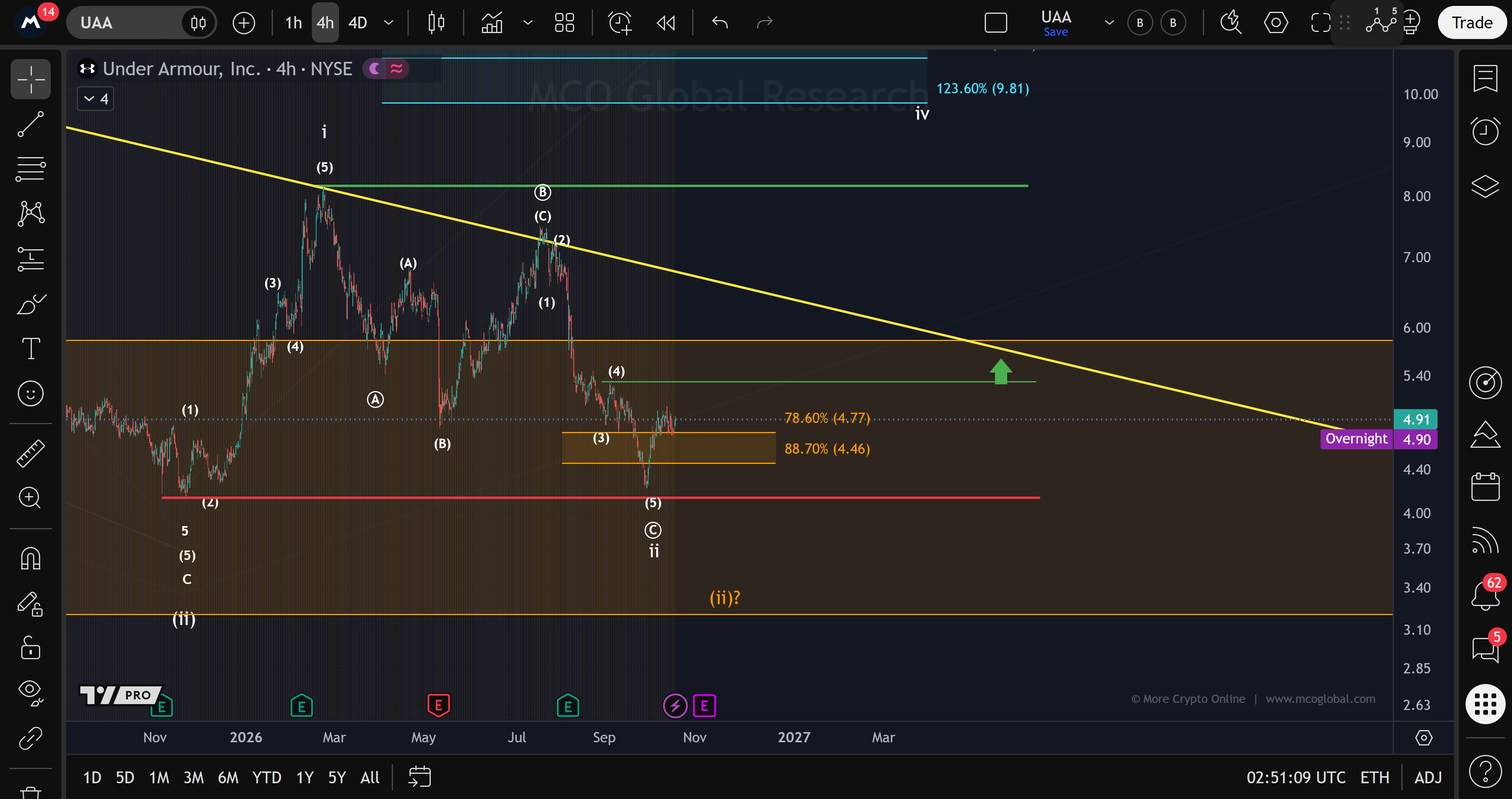
Under Armour has the most fragile setup of the three. In the video's assessment, the stock remains caught in a very long correction. Repeated recovery attempts have not yet produced a convincing upward impulse. An appealing theoretical balance between potential upside and downside does not replace that missing strength.
For the short-term setup, $4.10 is the key lower boundary. A break would invalidate this particular pattern and open the door to a return to the larger correction; the analysis identifies approximately $3.20 as a lower reference point. The possibility of a later long-term bottom would not preserve the failed short-term setup.
On the upside, $5.33 is the first important signal level. A move above it would represent progress, but would need to be accompanied by greater momentum and a sustainable structure. The four-hour chart illustrates why caution remains appropriate: the descending trendline is still above price.
The next scheduled test is for Adidas
Adidas also has a specific date ahead. The company is scheduled to release its nine-month results on 29 October 2026, according to its official financial calendar. The release can provide new information; its effect on the share price is unknown. Until then, the question is whether the stock can maintain its recovery and challenge the next resistance levels.
The comparison therefore leaves three different developments to watch: a continuation of the recovery already visible at Adidas, the formation of a larger upward pattern at Nike, and an initial convincing show of strength at Under Armour. Brand recognition and large past price declines settle none of these questions. What matters is the evidence the market produces next.